
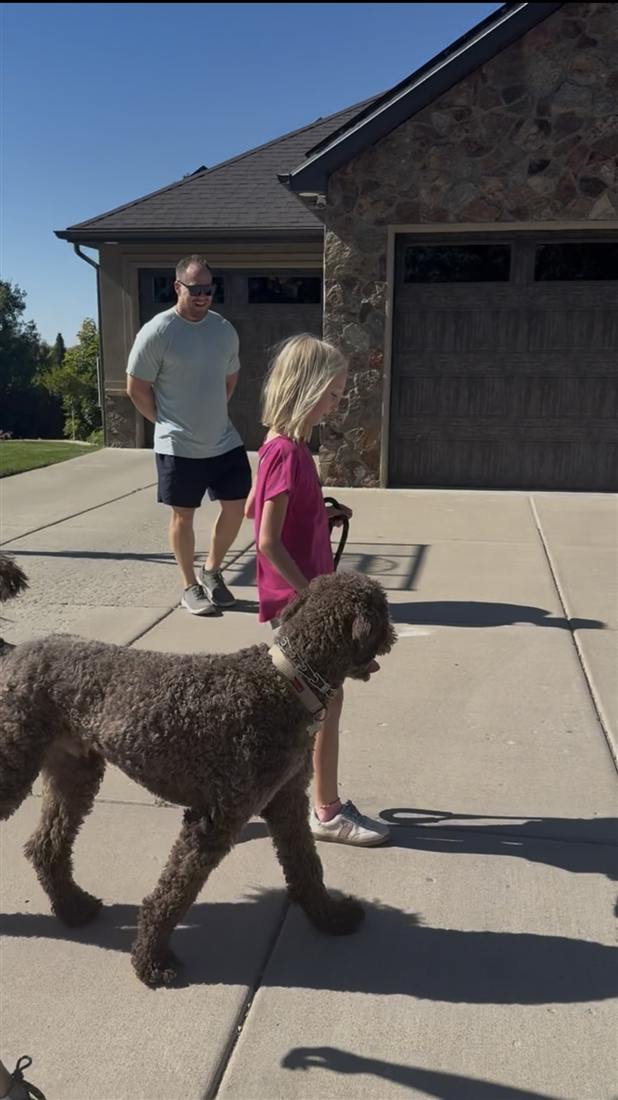
The pride is real. The protection usually isn't.
I hear it almost every week, usually with a little smile: "He's just protective of me." It's said like a compliment, like the growling at guests or the stiffening on the couch is proof of how much the dog loves them. That bond is often real. The protection, in the way people mean it, usually isn't.
What's actually happening in most of these cases has very little to do with loyalty and a lot to do with anxiety, or resource guarding, just aimed at a person instead of a bone or a toy.
What this behavior actually looks like
- Stiffening or growling when someone approaches you, especially on the couch, in bed, or in the car.
- Positioning between you and a visitor, physically blocking access before anything else has happened.
- Snapping or lunging when a stranger reaches toward you, not toward the dog.
- Being noticeably calmer around that exact same person when you're not in the room.
- Escalating in tight spaces, doorways, hallways, the car, where you're both close together and there's nowhere for the dog to create distance.
Why dogs actually do this
- Under-socialization. Limited positive exposure to unfamiliar people means strangers register as uncertainty rather than something neutral.
- Anxiety and attachment. You're often the one predictable, safe thing in an uncertain moment, so the dog manages that uncertainty by controlling who gets close to you.
- Resource guarding, generalized. Mechanically, it's the same behavior as guarding a bone, just applied to a person instead of an object.
- Reinforcement history. The stranger backs off, or you soothe the dog mid-growl ("it's okay, buddy"). Both teach your dog that the behavior works.
- Genetics. Some breeds bred for watchfulness carry a naturally lower threshold for wariness, which calls for proactive structure, not celebration.
Why the distinction actually matters
Real protection work is a deliberate, professionally trained skill built over years in dogs specifically bred and conditioned for it. It isn't something that shows up on its own in a family pet. A dog who's anxiety-guarding isn't making a calculated threat assessment. They're reacting to their own discomfort, and that reaction can escalate unpredictably, toward a child, a friend, a delivery driver, not just toward an actual threat. If this sounds familiar from walks too, it's worth reading about what causes dog reactivity, since the mechanics overlap a lot.
The framing also changes what you do next. Praise and pride reinforce the behavior. Recognizing it as anxiety opens the door to actually helping your dog feel less on-guard, which is what they need a lot more than credit for loyalty.
A dog who feels secure doesn't need to guard you. Guarding is what a dog does when they don't feel like anyone else, including you, has the situation handled.
What actually helps
- Controlled, positive exposure. Let your dog meet visitors and strangers at a distance they can handle without reacting, then build from there.
- Don't soothe the behavior in the moment. Calm, matter-of-fact redirection teaches your dog there's nothing to manage. Reassurance mid-growl teaches the opposite.
- Build your dog's own confidence, not just their attachment to you. A place command, structured downtime away from your side, and consistent rules all help.
- Get the whole household consistent. If one person coddles the behavior and another corrects it, your dog gets mixed signals and the pattern holds.
If your dog does this, it's not a flaw and it's nothing to be ashamed of. It's also not something to encourage. The dogs I see improve the fastest are the ones whose owners stop bragging about it and start addressing it.